



TB-500 – what is this peptide and how does it work?
TB-500 is a synthetic peptide most often discussed in the context of muscle, tendon and ligament regeneration and wound healing. Its action is primarily associated with actin regulation, cell migration, the formation of new blood vessels and tissue remodeling.
However, a key distinction is often overlooked: some of the effects attributed to TB-500 come from studies on full-length thymosin beta-4, rather than on the seven-amino-acid fragment itself. In this article, we explain exactly what TB-500 is, how it may work, which effects are associated with it and what the available research actually shows.
Disclaimer: This material is for educational and informational purposes only. Its aim is to present the current state of knowledge and directions of research on TB-500. The content does not constitute medical or pharmaceutical advice or a recommendation regarding the use, dosing or administration of the peptide described. TB-500 is presented solely in a research context; it is not intended to diagnose, treat or prevent diseases, or for use in humans or animals.
What is TB-500?
TB-500 is a synthetic peptide composed of seven amino acids. It is a fragment of thymosin beta-4 — a naturally occurring molecule involved in regulating cellular processes related to, among other things, actin and cell migration.
The sequence of TB-500 is written as Ac-LKKTETQ. The prefix “Ac” indicates the presence of an acetyl group at the beginning of the chain. This modification may affect the peptide’s stability and how it is metabolized.
TB-500 and thymosin beta-4 – are they the same substance?
No. Thymosin beta-4 is the full-length molecule, whereas TB-500 is a short fragment of it.
Full-length thymosin beta-4 consists of 43 amino acids and occurs naturally in the body. One of its best-characterized functions is regulating actin — a protein that helps cells maintain their shape, change their structure and migrate.
TB-500 contains seven amino acids corresponding to a specific fragment of thymosin beta-4. It may therefore exhibit some of the activity associated with this region, but it is not a full equivalent of the entire molecule.
| Feature | TB-500 | Thymosin beta-4 |
| What is it? | A synthetic peptide fragment | A naturally occurring molecule |
| Number of amino acids | 7 | 43 |
| Relationship | A fragment of thymosin beta-4 | The full-length molecule |
| Extent of direct research | Limited | Much broader |
Findings from research on full-length thymosin beta-4 help explain the biological significance of the TB-500 fragment, but do not automatically confirm that the two molecules have identical effects.
How does TB-500 work?
The potential action of TB-500 is associated with its effects on several processes needed to rebuild damaged tissue. The peptide is studied primarily for its potential to:
- help repair cells reach the injury site;
- support the formation of new blood vessels;
- regulate the course of the inflammatory response;
- support collagen production and tissue remodeling.
These mechanisms may complement one another. More efficient cell migration allows repair to begin sooner, new vessels improve the supply to the damaged area, and collagen forms the foundation of the structure being rebuilt.
May support repair cell migration
One of the main areas of TB-500 research is its possible effect on actin — a protein that helps cells change shape and migrate.
After an injury, the cells needed for regeneration must reach the damaged site. These include:
- collagen-producing fibroblasts;
- cells that form new vessels;
- cells that rebuild the skin;
- cells involved in muscle repair.
Full-length thymosin beta-4 regulates actin availability, and the fragment corresponding to TB-500 lies in a region important for this process. Studies have observed effects of Tβ4 on the migration of endothelial cells, which are involved in blood vessel formation.
The potential significance of TB-500 therefore lies in its ability to help repair cells reach where they are needed. Without this, even the production of collagen or other tissue components could not proceed properly.
May support the formation of new blood vessels
TB-500 is also associated with angiogenesis, the formation of new blood vessels.
For regenerating tissue, this means the possibility of improved delivery of:
- oxygen;
- nutrients;
- immune and repair cells;
- components needed to form new tissue.
An improved blood supply may be particularly important for tendons and ligaments, which naturally receive less blood than muscles. Angiogenesis may therefore improve the conditions under which they are rebuilt.
Studies on thymosin beta-4 and its fragments have observed increased migration of vessel-forming cells and the formation of new vascular structures.
May influence the course of inflammation
Inflammation is needed to initiate regeneration. It helps remove damaged cells and prepare the site for rebuilding. Problems arise when the response persists for too long and delays the transition to subsequent stages of healing.
Thymosin beta-4 has been studied for its effects on the signals that control the inflammatory response. Observations in laboratory models have included reduced activity of mechanisms responsible for producing certain pro-inflammatory substances.
The potential action of TB-500 would therefore not involve stopping inflammation completely. Its more likely significance concerns supporting a proper transition from clearing damaged tissue to rebuilding it.
May support collagen production and organization
Collagen is one of the basic components of skin, tendons and ligaments. It forms a structure that gives tissues strength and enables them to bear loads.
TB-500 is associated with the activity of fibroblasts — cells that produce collagen and other connective tissue components. The peptide’s potential effects may include both the formation of new tissue and the subsequent organization of its structure.
This is important because the amount of collagen alone does not determine the quality of regeneration. The fibers must be properly aligned and connected. Only then can the rebuilt tissue regain strength, elasticity and normal function.
Studies on full-length thymosin beta-4 have observed increased collagen deposition and improvements in selected wound-healing parameters.
How might this translate into regeneration?
The potential action of TB-500 can be presented as a sequence of complementary processes:
repair cells reach the injury site → new vessels form → the tissue receives an improved supply → collagen production begins → the new structure matures and regains function
The greatest potential of TB-500 therefore stems from its possible effects on several stages of regeneration at once, rather than just one. The peptide may support both the initiation of repair and the creation of conditions needed for subsequent tissue rebuilding and strengthening.
Most data on these mechanisms come from studies of full-length thymosin beta-4 and its fragments. The direct action of TB-500 requires further research, but the available findings provide a biological rationale for studying it in the context of muscle, tendon, ligament and skin regeneration.
What does research on TB-500 show?
The key conclusion is simple: there is a biological basis for TB-500 to influence processes related to tissue regeneration, but its efficacy in humans has not yet been well established.
Laboratory and animal studies have observed processes that may be relevant to healing — including cell migration, the formation of new blood vessels and the rebuilding of damaged tissue. However, most of these findings concern full-length thymosin beta-4 or its fragments, rather than TB-500 itself in the form described in this article.
What research has been conducted directly on TB-500?
Direct research on TB-500 has so far focused mainly on its structure and how it is broken down in the body. It has not, however, examined whether the peptide accelerates muscle, tendon or ligament regeneration in humans.
In 2012, scientists examined the composition of a product labeled TB-500. They established that it contained a short fragment of thymosin beta-4 with the sequence Ac-LKKTETQ. The study therefore identified what TB-500 is chemically, but did not assess its efficacy or effects on injury healing.[1]
In 2024, researchers examined what happens to TB-500 as it breaks down. The substances formed during this process are called metabolites. In a laboratory wound-healing assay, one of the metabolites showed greater activity than TB-500 itself.[2]
This may mean that some of the action attributed to TB-500 comes not from the peptide itself, but from substances formed after it is metabolized. However, this is a laboratory finding that does not yet answer whether TB-500 improves regeneration in humans.
What has been observed in studies on full-length thymosin beta-4?
Much more research has been conducted on full-length thymosin beta-4, the larger molecule of which TB-500 is a fragment.
In a study on rats with full-thickness skin wounds, thymosin beta-4 was associated with faster epidermal regeneration, the formation of new blood vessels and collagen deposition. A faster reduction in wound area was also observed.[3]
Another experiment examined full-length thymosin beta-4 and a short peptide containing its actin-related fragment. Improvements in selected stages of skin repair were observed in aged mice.[4]
These findings show that both full-length thymosin beta-4 and some of its fragments may influence processes needed for tissue healing. However, the studies were conducted in animals. They do not establish whether similar effects will occur in humans or whether they apply specifically to the acetylated form of TB-500.
Has thymosin beta-4 also been studied in humans?
Yes, but the clinical studies primarily concerned full-length thymosin beta-4, not TB-500.
A phase II study involved 73 people with venous leg ulcers, which are hard-to-heal wounds associated with impaired venous circulation. Thymosin beta-4 was applied topically to the skin. The findings indicated that one of the concentrations studied may have accelerated healing, particularly in smaller wounds.[5]
Full-length thymosin beta-4 has also been studied in the form of eye drops. A controlled study in people with severe dry eye disease observed improvements in some reported symptoms and in the condition of the ocular surface.[6]
These studies show that full-length thymosin beta-4 can produce measurable biological effects in humans.
What can be concluded from the available research?
Research indicates that thymosin beta-4 and some of its fragments may participate in processes important for regeneration, such as:
- cell migration to the damaged site;
- the formation of new blood vessels;
- epidermal regeneration;
- collagen production and organization.
What effects are associated with TB-500?
TB-500 is studied primarily for its potential to support regenerative processes. Its potential action is associated with faster repair cell migration, improved blood supply to the damaged area, collagen formation and the rebuilding of tissue structure.
For this reason, the peptide is most often discussed in the context of muscle, tendon, ligament and skin regeneration.
TB-500 and muscle regeneration
In muscle injuries, TB-500 is primarily associated with the potential to:
- support the influx of repair cells to the injury site;
- improve the supply of oxygen and nutrients to the tissue;
- reduce a prolonged inflammatory response;
- support the rebuilding of damaged fibers;
- accelerate the restoration of normal muscle structure.
Studies on full-length thymosin beta-4 have observed an increased presence of cells involved in muscle regeneration. In an animal model, Tβ4 supported the mobilization of progenitor cells that may participate in damaged tissue repair.
The potential of TB-500 in this area therefore relates mainly to more efficient regeneration, rather than directly increasing muscle mass. Repairing a damaged fiber is a different process from its subsequent growth.
TB-500 and tendons and ligaments
In the context of tendons and ligaments, TB-500 is studied for its possible effects on:
- the formation of new blood vessels in tissue with a poor blood supply;
- the influx of collagen-producing fibroblasts;
- the formation of new connective tissue;
- the organization of collagen fibers;
- the gradual restoration of strength and elasticity.
Collagen organization is particularly important here. Simply producing new fibers is not enough — they must be aligned with the direction of the loads acting on them. Only then can a tendon or ligament effectively transmit force and stabilize a joint.
The potential effects of TB-500 are therefore not limited to faster tissue formation. They also include processes that may determine the quality of the rebuilt structure and its resistance to renewed overload.
Wound healing and skin regeneration
Skin healing is one of the best-characterized areas of research on thymosin beta-4 and its fragments.
TB-500 is associated with the potential to:
- accelerate skin cell migration toward the wound;
- support epidermal regeneration;
- increase the formation of new vessels;
- stimulate collagen production;
- reduce the area of damage;
- support scar maturation and strengthening.
In animal models, full-length thymosin beta-4 was associated with faster epidermal regeneration, increased angiogenesis, collagen deposition and a faster reduction in wound area.
Activity related to skin repair was also observed for a shorter fragment of this molecule. In a study on aged mice, a fragment containing the actin-related region supported selected stages of healing.
These findings suggest that some of the regenerative properties of full-length thymosin beta-4 may also be present in its shorter fragments. This is one of the main rationales for further research on TB-500.
Potential effects of TB-500 – summary
TB-500 is primarily associated with the potential to:
- support the regeneration of damaged muscles;
- accelerate the influx of repair cells;
- improve blood supply to damaged tissue;
- support the rebuilding of tendons and ligaments;
- increase collagen production and organization;
- accelerate wound closure;
- improve the quality of newly formed tissue;
- support the gradual restoration of function after an injury.
The greatest potential of TB-500 stems from its possible effects on several stages of regeneration at once — from cells reaching the damaged site, through improved blood supply, to the formation and strengthening of new tissue.
However, most data come from studies on full-length thymosin beta-4 and its fragments, and from laboratory and animal models. The direct effects of TB-500 in humans still require confirmation.
How long does it take for the effects of TB-500 to become apparent?
There are no published clinical data that reliably establish how long it takes for TB-500 to start working in humans. A single numerical answer would also be misleading, because “time to effect” may refer to several different stages:
- the presence of the peptide and its metabolites;
- the initiation of a cellular response;
- cell migration;
- the formation of new vessels;
- collagen production and organization;
- tissue remodeling;
- the restoration of its function.
Changes at the cellular level may begin before any noticeable improvement in structure or function. Remodeling is particularly slow in collagen-rich tissues such as tendons and ligaments.
The rate also depends on the type and extent of damage, the tissue’s blood supply, the model used and how the outcome is measured. Online claims giving a single fixed timeframe usually do not distinguish between these stages and are not based on controlled studies of TB-500 itself.
TB-500 – side effects and status in sport
There are currently insufficient human studies to establish a reliable list of common TB-500 side effects. This does not mean that the peptide is risk-free — it only means that its safety has not been thoroughly characterized.
What side effects may TB-500 cause?
The main problem is the limited amount of direct data. Safety studies conducted on full-length thymosin beta-4 do not automatically describe the effects of the shorter TB-500 fragment, because these are different molecules.
In practice, potential adverse effects may therefore arise from both the properties of TB-500 itself and the quality of the specific material. A product with a composition that does not match its specification, low purity or improper storage may behave differently from a correctly identified peptide.
A low number of reported side effects should not be interpreted as confirmation of safety. Without larger, well-controlled studies, the following remain unknown, among other things:
- how the body responds to TB-500 during prolonged exposure;
- whether interactions with other substances may occur;
- how often adverse reactions occur;
- whether some individuals are more susceptible to certain effects.
Is TB-500 permitted in sport?
No. TB-500 is a prohibited substance in competitive sport.
The World Anti-Doping Agency includes thymosin beta-4 and its derivatives, including TB-500, on its list of prohibited substances. The prohibition applies to athletes subject to anti-doping rules, regardless of whether the substance would be used to improve performance or accelerate regeneration.
TB-500 is not a conventional anabolic agent. Interest in it in sport stems primarily from its potential effects on repair processes and the possibility of a faster return to training. Under anti-doping rules, however, the purpose of use does not change its status.
Key conclusions
- The full side-effect profile of TB-500 in humans has not been established.
- Potential risks relate both to reactions to the peptide and to the quality and purity of the material.
- Data on full-length thymosin beta-4 cannot be treated as a complete description of TB-500 safety.
- TB-500 is on the WADA Prohibited List.
TB-500 and BPC-157 – how do they differ?
TB-500 and BPC-157 are often mentioned together because both peptides are studied in the context of tissue regeneration. However, they are not the same compound and are associated with somewhat different processes.
TB-500 is a short fragment of thymosin beta-4. It is studied mainly for its effects on cell migration, the formation of new blood vessels and the remodeling of damaged tissue.
BPC-157 is a synthetic peptide composed of 15 amino acids. Animal studies have evaluated it in the context of tendon, ligament, muscle and gastrointestinal tissue healing, among other areas.
Put simply, TB-500 is more often associated with creating the conditions needed for regeneration, such as cell migration and blood supply, whereas BPC-157 is more often studied directly in models of specific tissue injuries.
Can TB-500 and BPC-157 complement each other?
In theory, their mechanisms may be complementary. TB-500 is primarily associated with cell migration, vessel formation and tissue remodeling, whereas BPC-157 is associated with soft tissue repair, the activity of collagen-producing cells and vascular regulation.
This provides a biological rationale for the hypothesis that the two peptides could affect different stages of the same regeneration process.
However, there are no controlled studies comparing TB-500, BPC-157 and their combination. It is therefore possible to discuss potentially complementary mechanisms, but not confirmed synergy.
TB-500 in laboratory research
Accurate identification of the material is important in peptide research. A small change in the sequence, a modification at the end of the chain or the impurity profile may affect the sample’s properties and the results obtained.
When selecting research material, the following factors matter:
- conformity with the declared sequence;
- purity;
- substance content;
- molecular mass;
- the form of the material, such as a lyophilizate;
- storage conditions;
- batch number;
- availability of analytical documentation.
Research reproducibility requires the use of materials whose identity and quality are characterized as thoroughly as possible. Otherwise, differences between experiments may arise from the composition of the samples themselves, rather than from the mechanism being studied.
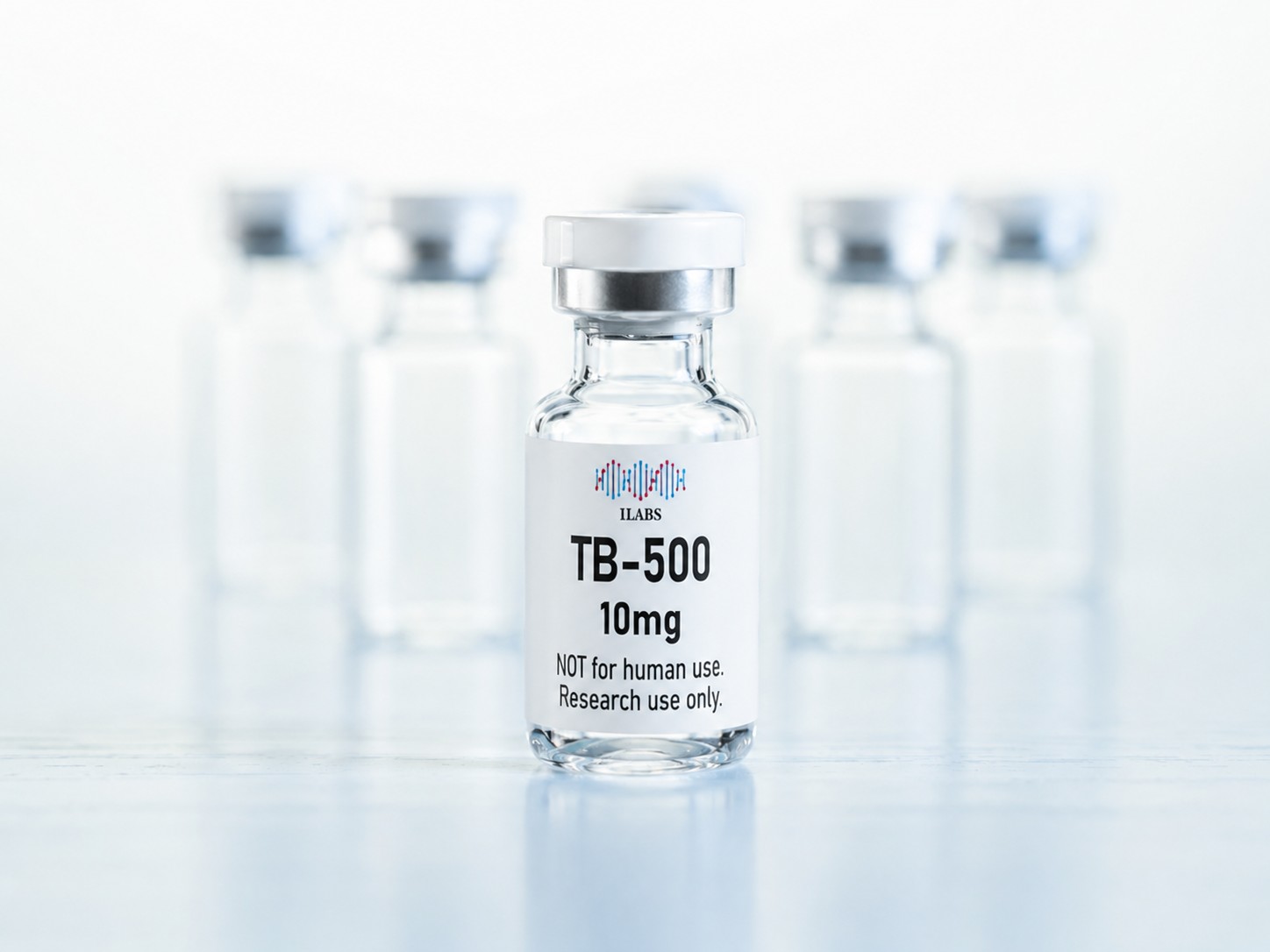
ILABS offers TB-500 10 mg in a form intended exclusively for laboratory applications. The product page provides its current specifications and information on intended use and storage.
Frequently asked questions about TB-500
Summary – what should you know about the action of TB-500?
TB-500 is a fragment of thymosin beta-4 studied for its possible effects on cell migration, the formation of new vessels, collagen production and tissue remodeling.
These processes may be relevant to muscle, tendon, ligament and skin regeneration. Current data provide a coherent biological rationale, but most come from laboratory studies, animal models and research on full-length thymosin beta-4.
TB-500 therefore has interesting research potential, but its direct effects in humans require further confirmation.
References
- Esposito S. et al. Synthesis and characterization of the N-terminal acetylated 17–23 fragment of thymosin beta 4 identified in TB-500, a product suspected to possess doping potential. Drug Testing and Analysis. 2012;4(9):733–738. DOI: 10.1002/dta.1402. PMID: 22962027.
- Van Troys M. et al. The actin binding site of thymosin beta 4 mapped by mutational analysis. The EMBO Journal. 1996;15(2):201–210. DOI: 10.1002/j.1460-2075.1996.tb00350.x. PMID: 8617195.
- Malinda K.M., Goldstein A.L., Kleinman H.K. Thymosin beta 4 stimulates directional migration of human umbilical vein endothelial cells. FASEB Journal. 1997;11(6):474–481. DOI: 10.1096/fasebj.11.6.9194528. PMID: 9194528.
- Philp D. et al. Thymosin beta 4 and a synthetic peptide containing its actin-binding domain promote dermal wound repair in aged mice. Wound Repair and Regeneration. 2003. PMID: 12581423.
- Malinda K.M. et al. Thymosin beta4 accelerates wound healing. Journal of Investigative Dermatology. 1999;113(3):364–368. PMID: 10469335.
- Rahaman K.A. et al. Simultaneous quantification of TB-500 and its metabolites in in-vitro experiments and rats by UHPLC-Q-Exactive Orbitrap MS/MS and their screening by wound healing activities in-vitro. Journal of Chromatography B. 2024. PMID: 38382158.
- ClinicalTrials.gov. TB-500 (Thymosin Beta 4 17–23 Fragment) for Cardiovascular Biomarkers in Stable ASCVD — TBRIDGE-CV. Study identifier: NCT07487363.
- U.S. Food and Drug Administration. Certain Bulk Drug Substances for Use in Compounding that May Present Significant Safety Risks.
- World Anti-Doping Agency. The 2026 Prohibited List — World Anti-Doping Code.
- Chang C.H. et al. The promoting effect of pentadecapeptide BPC 157 on tendon healing involves tendon outgrowth, cell survival, and cell migration. Journal of Applied Physiology. 2011. PMID: 21030672.